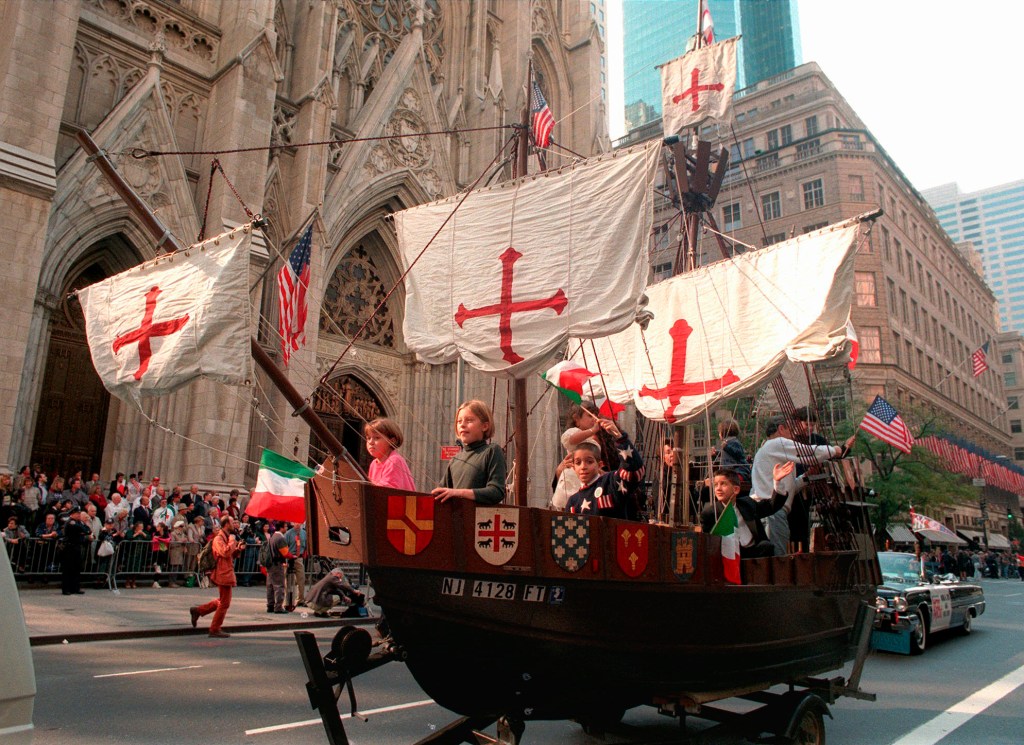
On an early autumn morning in 1492, three ships saw land after voyaging for weeks in search of a New World to advance the Spanish crown’s conquests.
Famously, the Nina, the Pinta and the Santa Maria were sent by Queen Isabelle I and King Ferdinand II of Spain to expand Europe. The mini-fleet’s leader, Christopher Columbus, was an Italian who was rewarded handsomely for his discovery of modern day San Salvador, which he thought at the time to be much closer to the East Indies.
Nevertheless, his travels and discoveries of lands inhabited by isolated indigenous communities were heralded for the riches they uncovered for Spain’s merchants and royalty, even as Columbus’ conquests exploited and endangered the native people who lived in the Americas.
Columbus’ voyages were celebrated as a holiday for the first time in October 1792. The Society of St. Tammany, also called the Columbian Order, had commemorated the then-300th anniversary of Columbus’ landing, according to the Library of Congress.
Several decades later, President Benjamin Harrison issued a proclamation in 1892, which recommended “to the people the observance in all their localities of the 400th anniversary of the discovery of America” and described Columbus as “the pioneer of progress and enlightenment.”
In the years that followed, other religious and fraternal groups urged states to formally declare Oct. 12 as a legal holiday in honor of Columbus. Colorado was the first to do so in 1907.
Then, Congress, by joint resolution in 1934 and modified in 1968 (36 U.S.C. 107), requested that the president proclaim the second Monday of October of each year as “Columbus Day.”
Despite its long history, the holiday has been controversial almost since its inception, and a growing number of states and cities have swapped Columbus Day for “Indigenous People’s Day, to acknowledge the painful history and atrocities experienced by Tribal Nations and communities following the arrival of European explorers.
At least 12 states and many cities have formally designated the second Monday in October as Indigenous Peoples’ Day or Native American Day. According to the Office of Personnel Management, though state and local governments and private businesses may use other names for holidays, it is the government’s policy to refer to holidays by the names designated in the law.
“It is a measure of our greatness as a Nation that we do not seek to bury these shameful episodes of our past — that we face them honestly, we bring them to the light, and we do all we can to address them,” President Joe Biden said in a proclamation on Columbus Day in 2021.
Federal workers do have Monday, Oct. 9, 2023, off of work in observance of Columbus Day, per the Office of Personnel Management. That means employees will have a long weekend and will get holiday pay on Monday.
The next federal holiday is Veterans Day on Friday, Nov 10.