For the better part of the decade, September in Washington has meant autumn leaves, pumpkin-spiced everything and the strong possibility that Congress will send the federal government into a screeching halt.
This year appears to be no different.
Unless a continuing resolution passes by Sept. 30, the near-annual tradition of a government shutdown threat appears to be upon us.
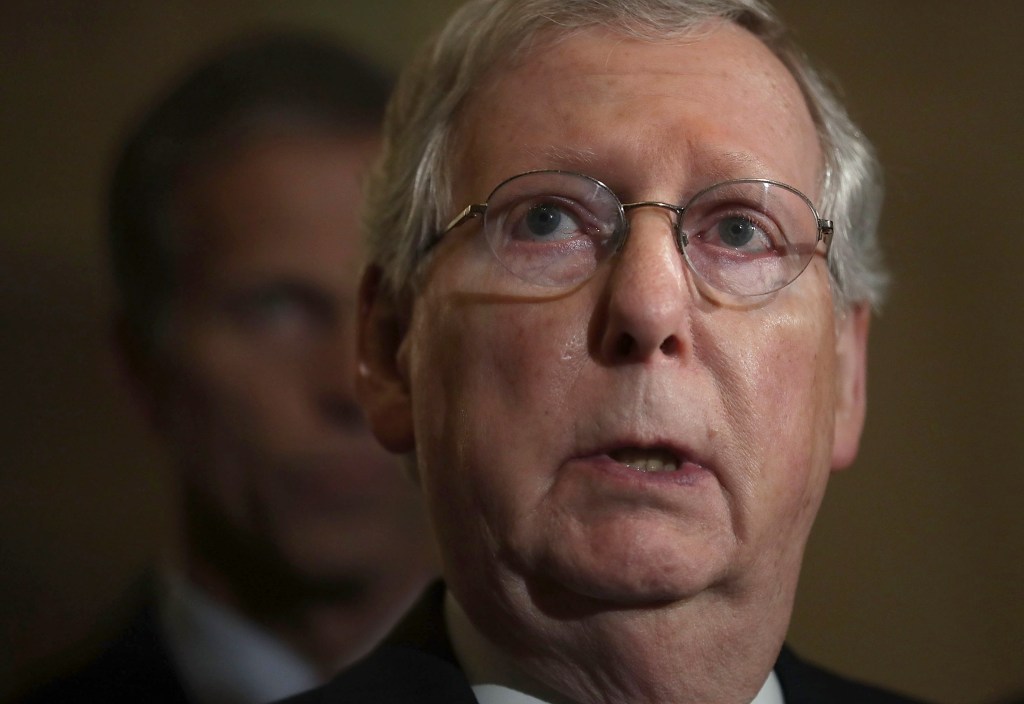
Democrats are threatening to block Senate Majority Leader Mitch McConnell’s, R-Ky., continuing resolution unless he includes relief funding for Flint, Mich., which is still reeling from its contaminated water crisis.
It’s far from unusual for a single issue to possibly derail the budget process, but this year’s shutdown season appears to have bubbled up slowly without the customary intrigue of wall-to-wall media coverage. Nevertheless, federal employees and the contracting community are eagerly awaiting the congressional equivalent of a half-court shot: the last-second CR.
“I think there is a kind of cynical confidence that somehow, Congress will manage to find some deal at the very last minute to pull us back from the brink,” said Don Kettl, professor and former dean of the School of Public Policy at the University of Maryland.
Kettl said that the drama of the presidential election has somewhat deflected from yet another budget impasse that has seeming become routine, following the same playbook of other funding conflicts on Capitol Hill.
But instead of another entrenched ideological battle, he said this latest skirmish represent more of a tactical repositioning of power as both parties to try to prognosticate the election results.
“There are lots of calculations about how Congress is going to end up shaking out after the election,” he said. “Democrats or Republicans may be in a stronger position in the lame duck session to able to put some of these [legislation initiatives] in place.”
But while the congressional machinations play out, federal employees and contractors are left watching the clock to see if a shutdown will occur.
“I think people are waking up to this potential right now, within days, hours of it actually happening,” said Robert Shea, a principal at Grant Thornton and a former associate director for administration at the Office of Management and Budget.
“You’re seeing probably stages of grief: denial, incredulity, anger and then resignation. Whether or not we actually get there? We’re not going to know that, I think, until pretty late in this week.”
Speculation not only centers on whether Congress will pass a CR or not, but how long one may last. A short CR could provide legislative leaders just enough time to compromise a broader deal or merely stretch out negotiations.
“Oct. 1 is a Saturday, which means that Congress realistically has all weekend to enact appropriations bills, because the government would not begin its process of shutting down until Monday,” said Alan Chvotkin, executive vice president and counsel of the Professional Services Council.
Chvotkin said that 2016 marks the 22nd year that Congress has not passed one or several appropriations bills, so government contractors have become adept at working under the likelihood of possibly multiple CRs while developing possible shutdown plans. Those plans include determining which contracts are already funded and how much work contractors can reasonably continue to do even while the government is shut down.
“Many government contractors have transitioned from wonderment: ‘What’s going on,’ to denial: ‘I can’t believe they can’t do this,’ to acceptance and with that acceptance comes first learning and preparation.”
But the necessity of those preparations, and an intrinsic need to deploy them every September, may mean that shutdown politics may be part of the status quo.
“I guess it could become the costs of the government doing business,” Shea said, “but that would be a shame.”